
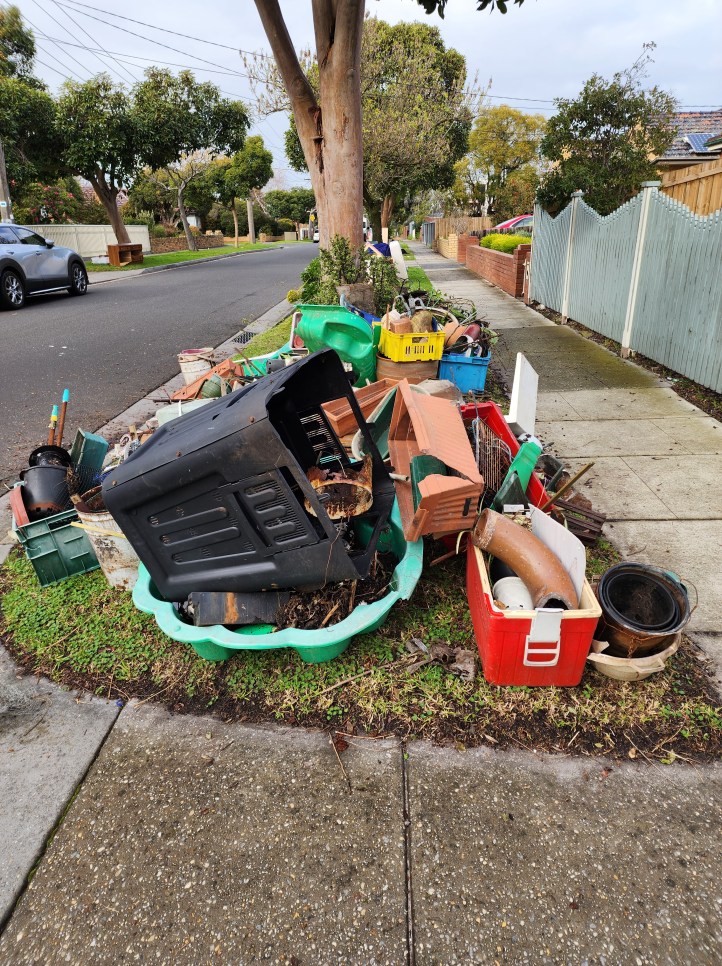
Recycling heaven or consumerist hell?
Hard waste day – what a uniquely Australian phenomenon. I had never heard of it until I moved to Melbourne, and the idea is both ingenious and utterly bizarre. One week each year where you can just dump your unwanted crap on the street, and not only will you not get into trouble, but the council will actually take it away for you, free of charge? It would never happen in the UK! Perhaps not least because we don’t have nature strips, but it’s hard to imagine the political will ever being there either. But I think this would be a wildly popular policy. Perhaps I should suggest it to the Greens?
Because hard waste day also functions as one great, big freecycle event. For a week you can browse the whole neighbourhood’s goods and take whatever you fancy. I myself have liberated a few items from a nature strip. On the other hand, perhaps the ease of disposal encourages people to be a little less careful with their sofas, more willing to pass on a dated chair? But I’m getting ahead of myself.
You can learn a lot about a neighborhood from their hard waste. Each suburb has its own character, and the numerous folks who scavenge from them must have their favourite places. Today, I’m going to sum up the ten most frequent finds in hard waste around my part of the world. They’re certainly not my favourite, but each tells a little story about the state of that household, the neighborhood, and the world. We’ve noticed that the quality of hard waste seems to have dived over the last year or two; perhaps a symptom of the cost-of-living crisis? Read on to see what’s still popping up, and please do share your own in a comment. I’d love to know what you see most! My list is in no particular order, they’re just the things I see all the time, on almost every street!
1. Clam Shell sandpit
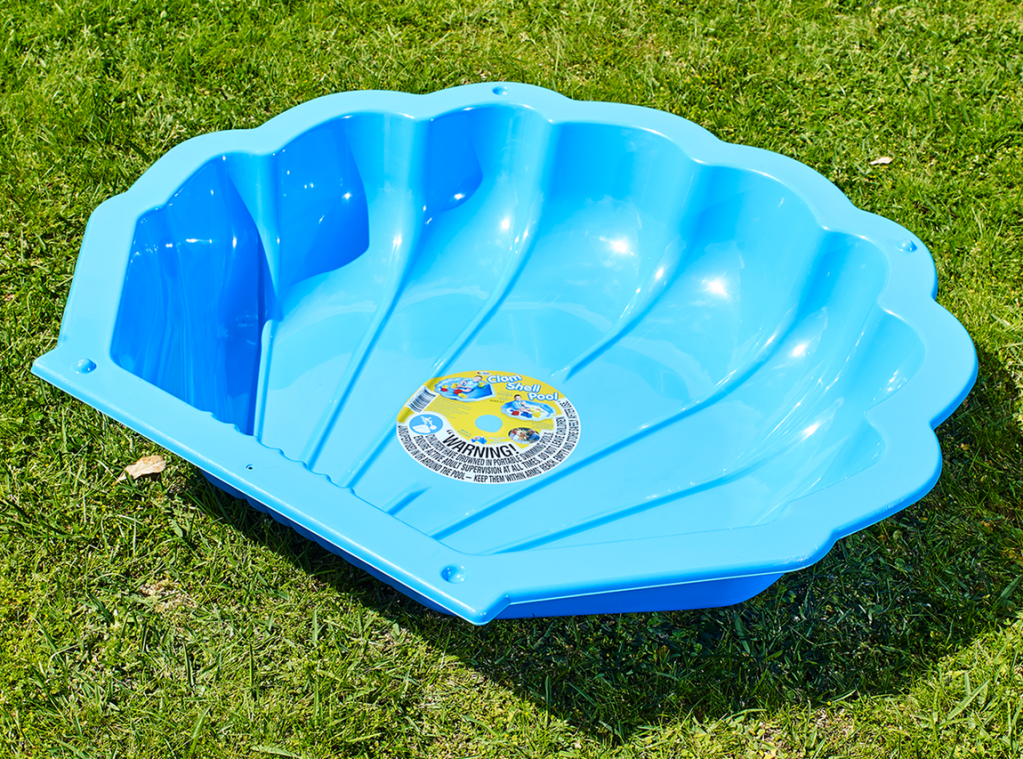
Every year I see so many of these out that it’s hard to believe there could be any left for the following one. But without fail, there they are! These ubiquitious blue plastic toys seem to outnumber children, and there’s no escaping them. This is a classic example of an item that hard waste week could in theory meet the demand for. If your children have outgrown them, put it out and pass it on to the next generation. But at just over $15, there maybe isn’t the price motivation to make people wait. So we get more plastic each year. I’m hoping that the council finds something fun to do with these – perhaps passes them on to families – but given the sheer volume, it seems unlikely.
2. Baby and child car seats
Of all the items I see out, this is maybe the one that troubles me the most. Car seats of all sizes and styles get thrown out, often seemingly in great condition. This is totally understandable; there is advice against buying them secondhand, as it’s hard to know whether they’ve been involved in a traffic incident – not to mention how difficult they are to clean. It is hard to imagine it’s at all possible to recycle these – they’re massive, heavy chunks of plastic with other materials attached and entangled. But they represent a huge expense, from hundreds to even thousands of dollars, certainly one of the biggest single purchases a family will make for their children. Their ubiquity at hard waste time points to a need for some official guidance and handling of such items, before the landfills look like theatres for children, stuffed with thousands of seats. If there was a mass scale, readily available way to safely pass these on to other families, that would be an enormous help. My council encourages residents to consider whether items can be resold, repaired or donated before putting it out for hard waste, implying they they’re not doing this themselves. So a way to organise redistribution of bulky and hard to recycle items like car seats, which there will always be a steady need for, would be fantastic.
3. Large but broken flower pots
Flower pots are one of those things that always surprise me with how expensive they are. So it’s a little heartbreaking to see lovely big ones, terracotta or wooden especially, with a big crack or chunk missing – and what happened to the plant inside? Mostly though I find these disappointing because I’m always on the look out for pots, so to see a good one from afar only to find it broken on closer inspection is a little gutting. Gardens in Australia, at least in older properties and out in the suburbs, seem on average to be larger than English ones. I suppose there is just more space to go around. So it is maybe surprising that there are so many container gardeners around. But in my experience, having a lot of space doesn’t negate wanting to cram as many plants in as possible, and make the most of every inch. Add to that the fact that many people in my neighbourhood grow their own fruits and vegetables, and I think it is a nice thing that so many plants are growing in pots. Perhaps all the broken ones are a sign that their occupants were growing very well, and needed transplanting? Let’s go with that!
Related but not quite the same, but a lot of little plastic garden centre pots are left on nature strips throughout the year. This black plastic is hard to recycle, so it’s nice that people attempt a bit of a circular system off their own backs!
4. Mattresses
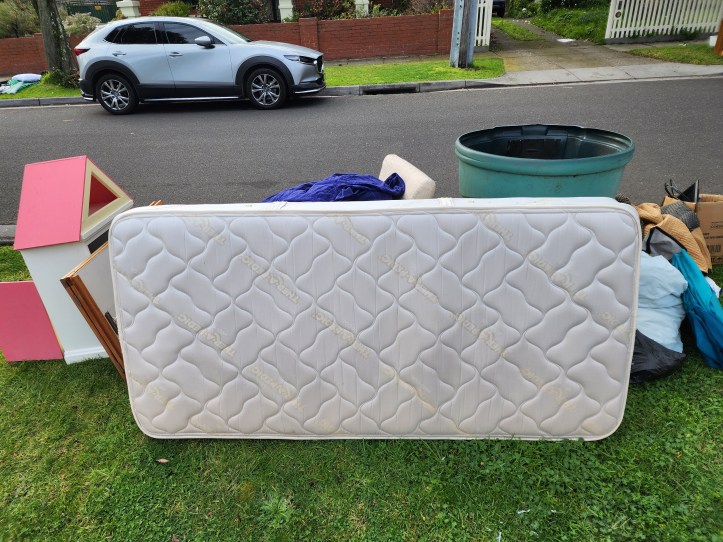
There are few things more depressing than an old mattress that has been left out in the rain. The weather seems to know that the mattresses have all been put out, because no matter how sunny it is when they go out, it will absolutely rain within the next 24 hours. Mattresses are a hard one to know what to do with. They’re bigger than many of us can fit in or on the car, they’re expensive so don’t get replaced all that often, and are hard to revive. If it gets to the point where you’re considering throwing them out, it’s probably too late. But there’s only so much you can do to refurbish, for example, a sprung mattress. Recycling them would be so labour intensive, breaking them down into their separate but stuck together parts, it seems unlikely that anyone is doing this, and from what I can tell, they mostly end up in landfill. Until a better solution is found, I suppose our best option is to flip, turn, vacuum and spot clean as best we can, to keep them going as long as possible. There is advice out there to change them every so many years, and while I sympathise with the call to cleanliness, it is hard not to think this was invented by mattress companies (and indeed it is most often them touting this recommendation).
5. Dining chairs and tables
Another one I am often tempted by! People will put out whole sets of slightly dated dining tables and chairs, which could quite easily have been donated. I think many people are not aware of how many charities will pick up larger furniture items for re-sale in op shops. There is a lot of pathos in a dining table: think of the meals shared, the conversations, the arguments! The hopes and aspirations they once embodied. Though they are prone to looking old-fashioned, I often think a bit of reupholstering and some sanding could breathe new life into them. I have yet to attempt this, but I can definitely see it in my future.
6. Desk chairs
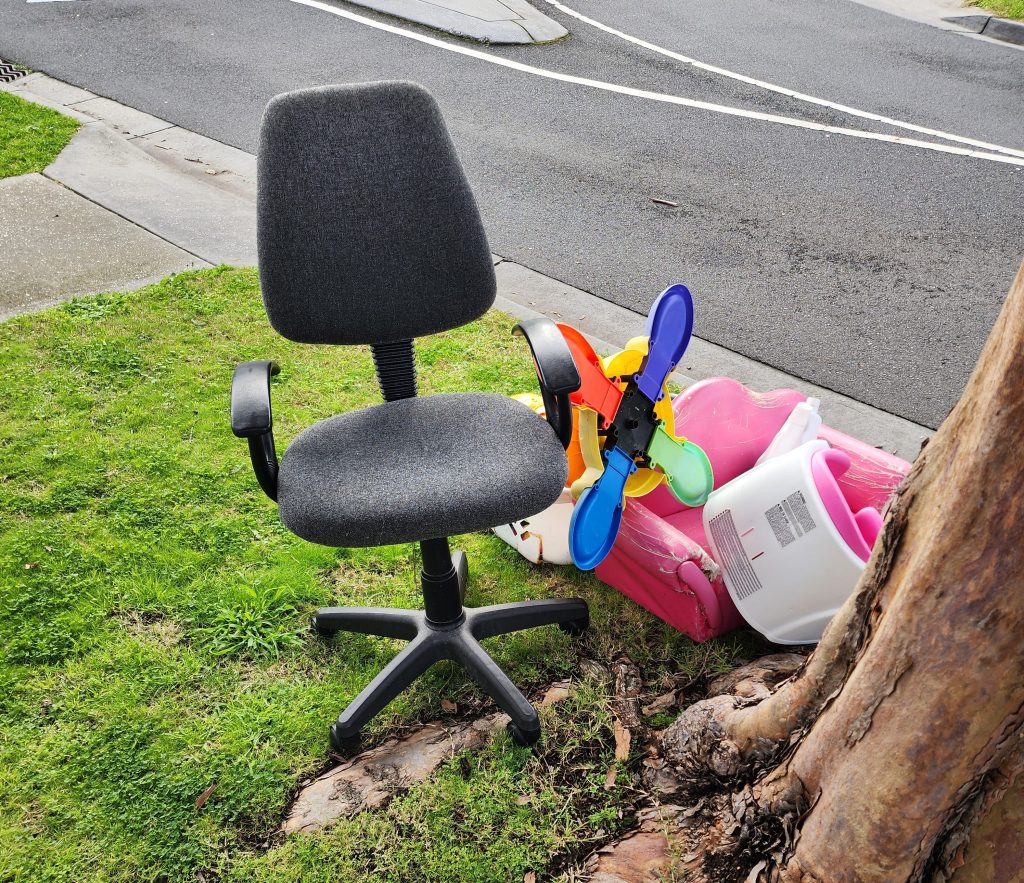
I’ve definitely noticed an uptick in the number of desk chairs out. Perhaps this reflects that we are an increasingly work-from-home society? Or maybe we’re all just one new desk chair away from true comfort. These run the gamit of quite fancy ones to absolutely bog standard, didn’t-know-they-still-made-them-like-that ancient looking ones. A significant subset is the very tired gaming chair. Desk chairs are often cited as the recyler’s nightmare – they’re made of mixed materials that are hard to break down and reuse in any way, let alone recycle. Once again, I feel the cost element has something to answer for here. Not many of us can afford the expense or time to save up for a really comfortable, nicely crafted desk chair. We need something right now, and preferably cheaply, so we spend maybe $50 max, and buy something that doesn’t quite do the job, gets worn out quickly, and is ugly to boot. Then the cycle starts over again.
7. Assorted agéd children’s toys
Perhaps the greatest consumers of our age: children. Or rather, people associated with children. It is pretty much impossible to resist the urge to buy children toys and presents. They very much dont have to actually be asking for things too: I am quite capable of buying them all sorts of random things on my phone, at the shops, basically every time I leave the house. But the huge numbers of old toys you see out at hard waste time shows just how harmful this can be. I really try to buy as little plastic as possible, and to accept that if I am buying something, we might be stuck with it forever. There are plenty and growing alternatives, from op shops to toy libraries, to try to get longer use out of toys. Perhaps the most important thing is to look after ones we already have. Once broken, they are difficult to fix in a way that remains child safe. Take the faded, perished plastic of the hard waste as your warning, and put the toy down!
8. Bundles of sticks
Another sigh that my neighbourhood is full of happy gardeners and equally healthy gardens. This is a bit of waste I can fully get behind, as people jump on the opportunity to give everything a good prune and throw out the waste. If you don’t have a woodchipper at home, at least you know it will be going to make woodchips for someone else.
9. Bedframes
This feels like another item which is prone to changing fashions. But it’s also at the mercy of changing living arrangements. Often one sees these outside rented accommodation at the end of tenancies, begging the question why can’t we do something for systematic to help renters pass on decent quality furniture? They’re bulky and unwieldy, losing just one bolt can render the whole thing useless, and they can weigh a ton. It would be great if they could be treated more as lifetime purchases, and passed on either to op shops or directly on to new homes. Online marketplace are a good option, but not everyone’s car will be big enough to hold even a deconstructed bed frame, so again, op shop collections services could be a good port of call.
10. Things that arent allowed
By far and away the most popular category! From too many mattresses to polystyrene to cardboard, there are so many things that end up in hard waste that shouldn’t be there. My council seems to collect them anyway, as they all disappear, begging the question why bother with the rules at all? I think they are to encourage people to seek responsible alternatives. My local waste transfer does take polystyrene, and we have roadside recycling of cardboard, for instance. Perhaps the rules, even if often broken, encourage people to learn more about what it out there. But while we let people off breaking them, we will still see so much waste go to landfill unnecessarily.
So there we have it, a mixed (rubbish) bag of hard waste! It’s always interesting from both a nosy neighbour and a sustainability perspective to take a look through and see what people are throwing out. While there are encouraging signs, we still have a long way to go in terms of reducing our waste to healthy long-term levels.
What do you do to reduce your waste? I’d love to hear your top tips and advice for how to cut waste of all kinds, and what has worked for you for making this a habit!

