
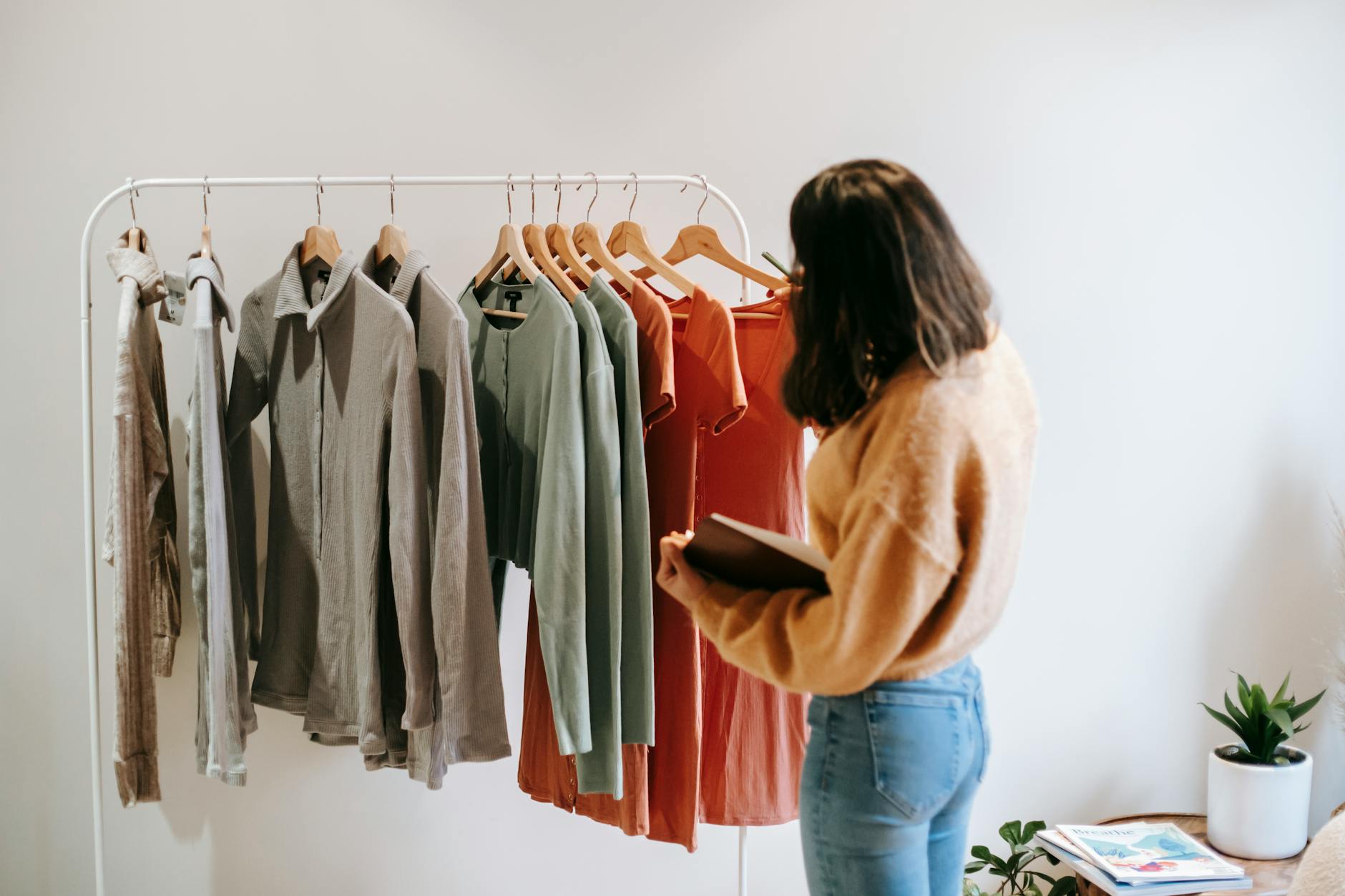
A realistic approach to resetting your wardrobe for the new year
‘New Year, new you’ often translates as ‘new year, new wardrobe’. The urge to purge at the end of the year and start afresh as the calendar switches over is powerful. The year 2024 saw a trend of advice not on what clothes to buy, but which to say goodbye to, itself a manifestation of the constant quest for newness. Add to that the ever-faster trend cycle, and it can be tempting to gut your wardrobe and start over.
But if we’re honest, it is very hard to find genuinely sustainable ways to ‘get rid’ of our clothes. If you’re ‘over’ something, the chances are high that everyone else will be too. You often hear complaints about thrift/charity/op shops being over-run with lots of the same item as soon as a trend has passed -how many denim maxi skirts are we seeing now? It’s difficult to guarantee that a piece you part ways with won’t end up in landfill. Between 2018 and 2019, Australians bought an average of 56 new items each year, for a total of 383,000 tonnes. Compare that with 210,000 tonnes being donated or re-used annually, and you can see that many of us must be passing on a lot of items each year.
When you take all of this into account, removing something from your wardrobe actually becomes a pretty big decision. It’s important to consider meaningful, significant reasons for wanting to part ways with an item. So today I’m sharing some tips I use myself when deciding whether something should stay in my closet, with five types of clothing you can get rid of in 2025.
1. Anything you can pass on to a real person
Perhaps the easiest way to guarantee your clothes will actually get a second life is to hand them to an actual person. I don’t mean Vinted or Facebook Marketplace, where the appeal of shopping can cloud a person’s judgement as to whether they really want something. I mean a real person in your life: a family member or friend, who you know will actually wear it. Maybe they’ve admired the piece, or you know it fits their vibe. If you can pass a piece on to a loving home, it takes some of the uncertainty out of the equation, and you can feel lighter about parting with it.
2. Pieces you bought because you felt you should
This is a bit of an all-encompassing one, but what I mean is any piece you bought out of some kind of obligation. Maybe it was a trend piece you bought because everyone else was wearing it, or a workwear item you felt you had to buy to fit in. If you’re no longer wearing these pieces and don’t feel any love for them, it’s ok to admit that they mismatch what you want from your wardrobe, and pass them on. Our clothes should be pieces we love and want to cherish, things that make us feel confident and fulfilled. If an item isn’t doing this for you, it’s ok to clear space and pass it on.
3. Any items that are too big or too small (and always have or will be)
Hanging on to clothes that don’t fit is something my feelings have evolved on since I had a baby. There are a whole host of things that were too big originally but fit at some stage of my pregnancy, and postpartum it’s taken a good while to fit back into some of my old staples. There are still plenty of things that don’t fit, or fit differently. So it’s safe to say I’ve gained a new perspective on this issue! But if anything, it has made me more critical: if something was too small before, there’s basically no hope of it fitting now! And if it was still too large when I was pregnant, there’s never going to be a time it will fit. My takeaway is that you shouldn’t hold on to pieces for a theoretical or imagined body change that might happen to you – only real ones count. If something is too small, don’t burden yourself with an invented obligation to change yourself to fit it. If it’s too big, and you don’t have a big life event like a pregnancy, don’t take up space with something you will realistically never wear. I’ve told myself that I’ll try the oversized look with various pieces over the years, but there is a noticeable difference between ‘designed to be oversized’ and ‘it just doesn’t fit you’. Do yourself the favour of owning pieces for the body you have, not the body you might one day have, maybe, if you change a load of things about it.
4. Gaping shirts
This has been a bugbear of mine for a long time – there is just something especially frustrating about picking out a beautiful shirt only to find that the buttons gape at your chest. I had this problem when I was a relatively modest cup size pre-pregnancy, so you can imagine how much worse it has got since baby and breastfeeding has considerably upped my cup size. Surgery, medication, and breastfeeding aside, there aren’t many things that change the size of your chest significantly, particularly not downsizing. Any hack you’re sold to fix gaping is only a (literal) stop-gap measure, and won’t really change the fit of the top (in fact in some cases may make it worse!). So treat yourself to a break from the anxiety, and pass any gaping shirts to your smaller-chested friends.
5. ‘Wrong’ colour items
Colour analysis has really blown-up in the last couple of years, going from extremely suburban and dated to apparently essential for every chic It Girl. As someone with a background in art history, you might think I’d believe in all types of colour theory. But I just can’t get behind colour/season/tone analysis. Aside from seemingly being incredibly white-person focused, to me clothes and colour are about personality and preference, not just what is ‘flattering’. So when I say ‘wrong colour’ I mean whatever feels wrong to you, not what any arbitrary system tells you is wrong. Some colours just work for us – we feel good in them, they make us happy. Others just don’t quite sit right, even if we like them as colours in their own right. Over the years I’ve picked up yellows, blues and oranges that I love, but trial and error has shown them to just not feel right on me. So take a look at your wardrobe and ask ‘how does this colour make me feel?’ If it’s one you’re not excited to wear, that doesn’t inherently make you feel good, then it’s worth passing on.
So those are my big tips and ideas I try to bear in mind when assessing my wardrobe. I honestly don’t throw away many clothes these days, trying instead to have the approach that if something makes it into my wardrobe, it needs to stay there. So these also work as questions to consider when you’re shopping. I hope they’re helpful, and I’d love to hear any tips you swear by! Please share them in a comment below, and thank you for reading.
 The Feminist Gadabout